

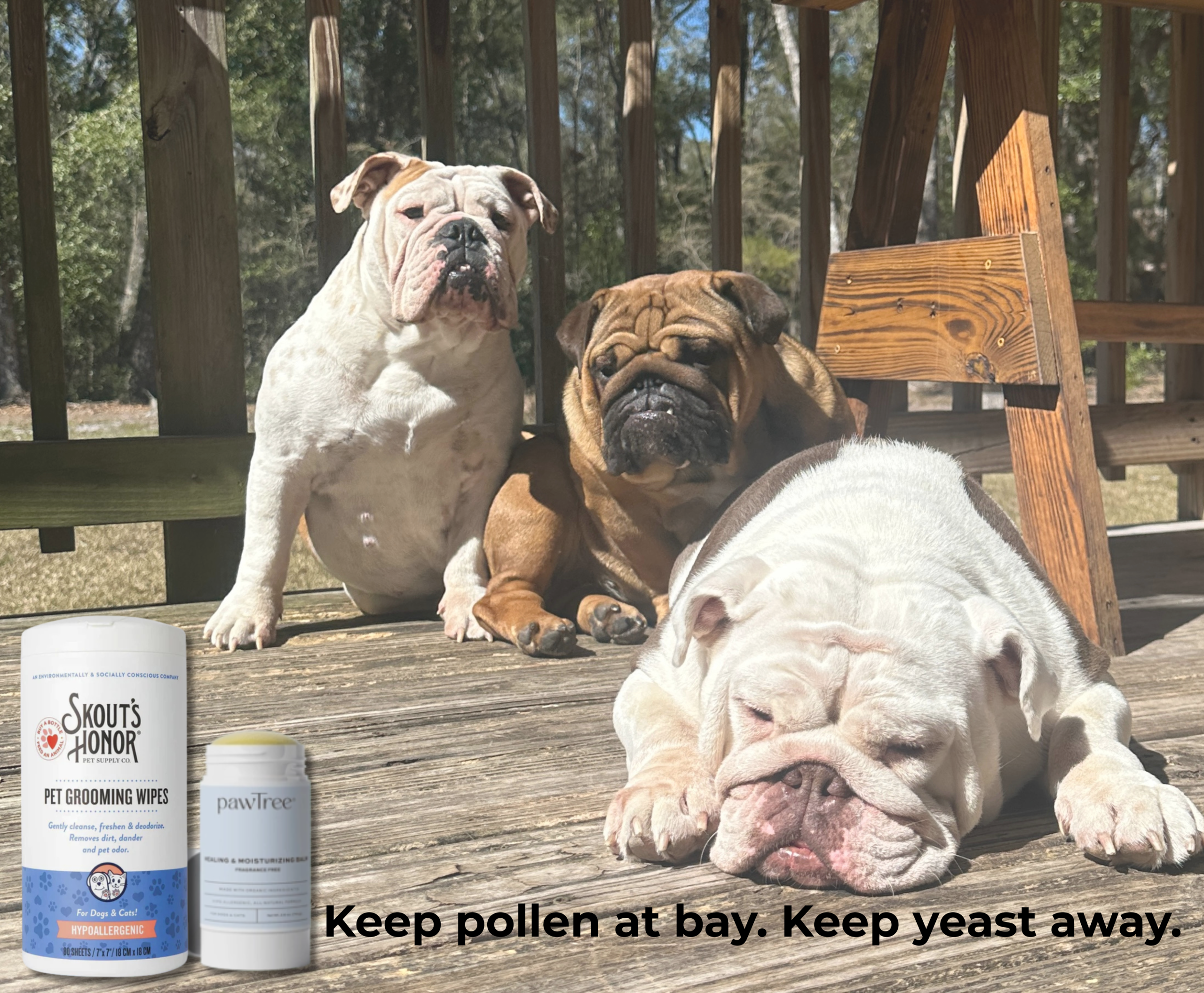
When people think about pollen, they think about allergies.
Sneezing. Itchy eyes. Maybe some scratching.
But with Bulldogs, it’s rarely that simple.
Because what looks like “just allergies” is often something else entirely happening underneath the surface.
And if you miss that, you end up chasing symptoms instead of solving the problem.
It’s Not Just Pollen—It’s What Pollen Creates
Pollen by itself isn’t always the issue.
It’s what happens after your dog comes in from being outside.
Pollen settles into:
- Wrinkles
- Paws
- Under the chin
- Around the eyes
- Along the belly
And once it’s there, it mixes with moisture, warmth, and natural oils.
That combination?
That’s where problems start.
Why Bulldogs Are More Affected Than Other Dogs
Bulldogs aren’t built like most breeds.
They have folds that trap debris, moisture that lingers longer, and skin that’s already working harder to stay balanced.
So when pollen gets introduced into that environment, it doesn’t just sit there.
It gets held in place.
And that creates the perfect setup for irritation, imbalance, and yeast overgrowth.
When “Allergies” Are Actually Yeast
This is where a lot of people get tripped up.
They see:
- Red paws
- Itchy skin
- Head shaking
- Face rubbing
- That musty or slightly sweet smell
And it gets labeled as allergies.
But what’s often happening is that pollen has disrupted the skin just enough to allow yeast to take over.
Now you’re not just dealing with an external trigger—you’re dealing with something that’s multiplying.
And that’s why it doesn’t go away on its own.
Preparation Starts Before They Even Go Outside
This is one of the easiest ways to stay ahead of pollen—but it’s also one of the most overlooked.
Before your dog goes outside, you can create a light barrier in the areas that are most vulnerable.
We’ll do a quick strip of nose and paw balm through the heavier portions of the wrinkles.
What that does is help prevent pollen from sitting directly on the skin, which can reduce irritation before it even starts.
Now—with that being said—it’s not a “set it and forget it” step.
Because that balm will also catch and hold pollen.
So when your dog comes back inside, you need to be intentional about removing it.
Wipe down the folds, clean the area, dry it thoroughly—and then reapply if needed.
For heavier wrinkled dogs, this matters even more.
In those cases, a waterless shampoo can help you get deeper into the folds where pollen tends to settle.
Just make sure everything is fully dry afterward before reapplying any balm.
Because again—moisture is what turns this from irritation into a problem.
What It Looks Like in Real Life
This isn’t always dramatic.
It builds.
You might notice your dog licking their paws more than usual.
Maybe the folds look a little pinker.
Maybe the eyes are slightly irritated.
Maybe the smell is just… off.
That’s the stage where you can stay ahead of it.
Because once it fully turns into a yeast issue, it’s harder to bring back under control.
Why Daily Reset Matters More Than Treatment
With Bulldogs, prevention isn’t complicated—but it does need to be consistent.
Especially in spring.
Because you’re not trying to eliminate pollen.
You’re trying to remove it before it has time to sit and create problems.
That’s the difference.
What We Actually Do After Being Outside
This is part of our routine—not something we wait to do when there’s already an issue.
When the dogs come in, we do a quick reset.
Nothing excessive. Just intentional.
We focus on the areas that hold the most:
- Paws
- Folds
- Under the chin
- Around the eyes
Even a quick wipe-down makes a difference.
Because you’re breaking that cycle before it starts.
Moisture Is the Multiplier
Here’s the part that matters just as much as pollen itself—
Moisture.
If pollen sits in a dry environment, it’s irritating.
If pollen sits in a warm, damp fold?
Now you’ve created a breeding ground.
That’s why drying matters just as much as cleaning.
You’re not just removing debris—you’re controlling the environment it thrives in.
This Is Why It Feels Like It “Came Out of Nowhere”
A lot of people say the same thing:
“My dog was fine, and then suddenly they weren’t.”
But it’s usually not sudden.
It’s buildup.
A few days of pollen. A little extra moisture. A little less consistency.
And then it tips over.
Once you understand that, it stops feeling random—and starts feeling manageable.
The Way We Look at It
We don’t treat pollen season like a problem.
We treat it like something to stay ahead of.
Because Bulldogs don’t need perfect conditions.
They just need consistent ones.
A little preparation before they go out.
A quick reset when they come in.
And an understanding that what looks like “allergies” is often something deeper.
The Bottom Line
Pollen isn’t just about sneezing or itching.
For Bulldogs, it’s about what gets trapped, what stays damp, and what starts to grow.
And when you understand that—
You stop reacting to symptoms…
…and start controlling the environment that creates them.